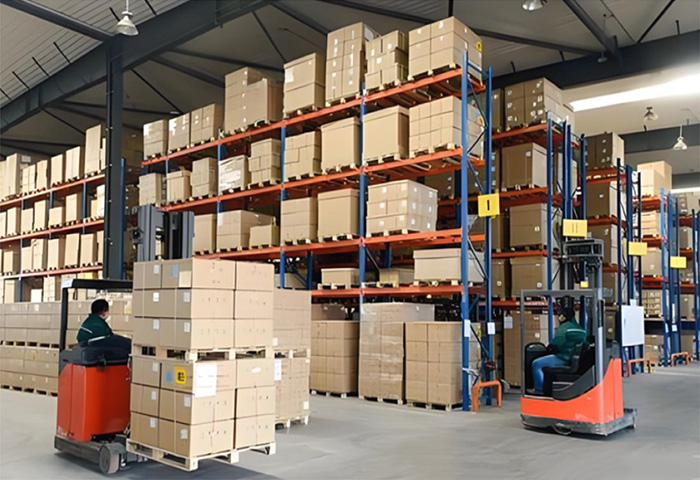
Putaway strategy is one of the core functions of a Warehouse Management System (WMS), directly impacting subsequent picking efficiency, inventory management, and space utilization. Choosing the right strategy is crucial. Below we introduce several mainstream putaway strategies. Below, we introduce several mainstream warehouse putaway strategies, the key benefits of getting them right, and best practices to help you optimize your operations.
1. Fixed Location Strategy
This is the most common, traditional, and simplest warehouse putaway method.
Core Idea:
Each product is assigned a fixed, dedicated storage location. Whenever goods are received, they are placed only in this designated spot, regardless of whether other locations may be more convenient at the time. This approach is often used in small warehouses with a limited and stable product variety, where the predictability of fixed locations outweighs the flexibility of dynamic alternatives.
Advantages & Disadvantages:
- Advantages: Simple to operate; staff require little decision-making and can memorize locations; stable and easy-to-manage inventory records.
- Disadvantages: Low space utilization – locations are often sized for peak inventory, leading to wasted space during low stock periods; inflexible, unable to adapt to changes in product sales velocity.
Applicable Scenarios:
- Low and stable number of SKUs.
- Large or heavy items that are inconvenient to move (e.g., home appliances, furniture).
- Goods with special storage requirements (e.g., hazardous materials, refrigerated items).
2. Random Location Strategy
Also known as the "floating location strategy," this is one of the fundamental strategies in modern WMS.
Core Idea:
Goods can be stored in any empty location that meets their storage requirements (e.g., temperature, weight capacity). The system tracks each item's location to manage inventory.
Advantages & Disadvantages:
- Advantages: Very high space utilization, making use of every available slot; flexible, adapting well to fluctuations in SKU count and inventory levels.
- Disadvantages: Highly system-dependent – difficult to operate without a WMS; picking paths can be inconsistent and longer since the same product may be scattered in different areas.
Applicable Scenarios:
- Warehouses with a large number of SKUs and high inventory turnover.
- Warehouses equipped with a mature WMS.
3. Class-Based Location Strategy
This is a compromise and optimization between fixed and random strategies, and one of the most commonly used and effective approaches in mature warehouses.
Core Idea:
Divide storage zones and use random storage within each zone. The most common classification method is ABC analysis, based on criteria such as sales value, shipping frequency, or volume.
- Class A: High-turnover, most important items (approx. 20% of SKUs, contributing 80% of shipments), placed in the most optimized, easily accessible locations (e.g., near shipping areas, at golden picking levels).
- Class B: Medium-turnover items, placed in secondary locations.
- Class C: Low-turnover items, placed in deeper, higher, or lower storage positions.
Advantages & Disadvantages:
- Advantages: Significantly optimizes picking efficiency, enabling pickers to complete most orders with minimal travel; balances space utilization and operational efficiency.
- Disadvantages: Requires periodic analysis and adjustment of product classifications.
Applicable Scenarios:
- Most warehouses that exhibit a clear "Pareto principle" (80/20 rule) in their operations.
4. Nearest Location Strategy
As the name implies, this strategy follows a proximity principle, also referred to as "adjacent location storage."
Core Idea:
The system recommends the nearest available and suitable empty location relative to the current operation point (e.g., receiving dock or picker's current position) for putaway.
Advantages & Disadvantages:
- Advantages: Reduces travel distance for putaway staff, improving putaway efficiency.
- Disadvantages: May disrupt an optimized overall layout (e.g., ABC zones), potentially placing hot items in suboptimal locations.
Applicable Scenarios:
- Often used in combination with random or class-based storage as a supplementary rule.
- Particularly effective in large warehouses with high volumes of putaway tasks.
5. How to Choose the Right Strategy?
There is no single "best" strategy – the choice depends on specific business needs. Key factors to consider include:
- Product Characteristics: Number of SKUs, variation in size/weight, inventory turnover rates (ABC analysis), seasonality, product affinity, special storage requirements.
- Warehouse Layout & Facilities: Area, shape, racking type, level of automation.
- Order Profile: B2B or B2C; number of order lines, common item combinations, picking methods (e.g., discrete order picking, batch picking).
- Technology Support: Level of automation; availability of a robust WMS to support complex putaway logic.
Summary:
No single strategy fits all scenarios. Successful warehouse operators flexibly apply and combine these strategies based on their unique business needs and continuously optimize as the business evolves. For most modern warehouses, a class-based storage strategy using ABC analysis is often the best starting point for balancing efficiency and cost. The table below summarizes the key aspects of each strategy for comparison:
| Strategy Name |
Core Idea |
Advantages |
Disadvantages |
Applicable Scenarios |
| Fixed Location |
One product, one fixed location |
Simple management, easy to remember |
Low space utilization, inflexible |
Few, stable SKUs; large items |
| Random Location |
Any empty slot can be used |
Highest space utilization, flexible |
System-dependent; messy picking paths |
Many, volatile SKUs; with WMS |
| Class-based(ABC) |
Zoen by importance, random within zone |
Optimizes picking, balances efficiency |
Requires periodic category analysis |
Most warehouses following 80/20 rule |
| Nearest Location |
Recommends closest empty slot |
Reduces putaway travel time |
May disrupt overall layout optimization |
Supplementary to random/class-based |