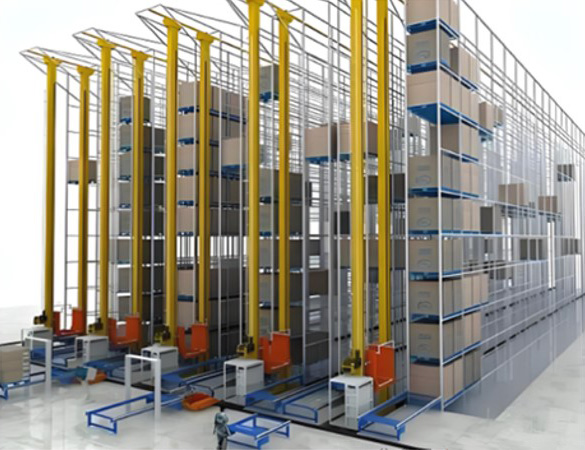
Designing rack cells requires precision, much like "tailoring a suit." The goal is to maximize space utilization while ensuring safe and reliable load handling. All dimensions must strike a balance between "safety clearances" and "space wastage." Using standard pallet dimensions (1200*1000*150mm) and a typical load height (1500mm), this document analyzes key design considerations:
I. Key Recommendations
The following dimensions are recommended for a double-load configuration: 2380mm (L) * 1100mm (W) * 1800mm (H).
1. Cell Length (Along Aisle): 2380mm
This dimension accommodates the pallet width (1000mm), lateral clearances (50-100mm on each side), and the gap between two pallets.
2. Cell Width (Across Aisle): 1100mm
This includes the pallet length (1200mm), operational clearance at the front (~100mm), and rear clearance (~50-100mm), ensuring the pallet can properly rest on the beams both front and back.
3. Cell Height: 1800mm
This accounts for the total load height (Pallet 150mm + Goods 1500mm = 1650mm) and vertical clearances (upper clearance ~100-150mm, lower space for beam height and safe lifting).
II. Design Methodology for Cell Dimensions
Determining cell dimensions centers on adding necessary operational and safety clearances to the unit load's outer dimensions.
1. Length (Along Aisle Direction):
The pallet length is 1200mm. Lateral clearances on both sides are required to accommodate manufacturing, installation, and operational tolerances for both the stacker crane and the racking. A typical single-side clearance ranges from 50mm to 100mm. For medium-height AS/RS with standard operating speeds, a clearance of 75mm-100mm per side is generally recommended.
2. Width (Perpendicular to Aisle Direction):
The pallet width is 1000mm. Sufficient front operational clearance (typically ≥100mm) is necessary for the stacker crane's forks to extend and retract smoothly. A rear clearance (usually 50mm-100mm) is also needed to prevent interference with rear components like brace rods.
3. Height:
The total unit load height is 1650mm (150mm pallet + 1500mm goods). The top vertical clearance is critical to prevent interference between the forks (or the load during lifting) and the upper beam or the load above. This should generally be no less than 100mm, with 100-150mm being advisable. The bottom clearance must account for the beam height and a safety margin for potential uneven pallet placement.
III. Key Design Considerations
Finalizing cell dimensions is just the beginning. The following factors are equally crucial for ensuring stable and efficient AS/RS operation.
1. Tolerances and Safety Clearances:
This is the most detailed aspect of design. It requires comprehensive consideration of stacker crane positioning accuracy, rack installation verticality tolerances, pallet dimensional variations, and potential long-term deformation of racks and equipment. All allocated clearances serve to absorb these tolerances and ensure uninterrupted load handling.
2. Rack and Stacker Crane Selection:
The choice between beam racks and cantilever (console) racks is significant. A beam rack cell typically holds 1-2 pallets, whereas a cantilever rack cell usually holds one, leading to differences in structural dimensions. Stacker cranes can be single-mast or double-mast; double-mast structures offer greater stability for taller applications and heavier loads, but their dimensions also influence the required aisle width.
3. Pallet and Load Characteristics:
Confirm whether the standard 1200*1000mm pallets are "stringer-type" or "double-face." This affects fork entry direction and the definition of cell depth. Load stability, overhang, or fragility also influence clearance requirements.
4. Overall Warehouse Layout and Efficiency:
The overall rack layout (number of aisles, rows, and tiers) should be determined based on storage capacity and throughput requirements. The Height-to-Length (H/L) ratio of the rack structure often has a recommended range (e.g., 1:4 to 1:6) to balance stacker crane efficiency and structural stability.
5. Industry Standards and Safety Regulations:
The design must comply with local fire safety and building codes. Future business changes should also be considered to incorporate a degree of flexibility into the design.