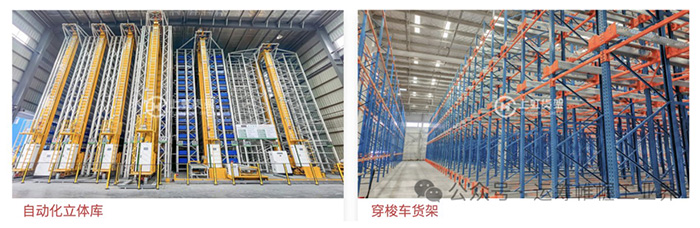
The importance of racking lies not only in its ability to significantly improve space utilization but also in laying the foundation for automation in warehouse operations. For example, Automated Storage and Retrieval Systems (AS/RS) can achieve 3–10 times or even higher space utilization compared with traditional floor stacking (depending on rack type, height, and operational methods). As a major breakthrough in storage technology, AS/RS has become the preferred solution in modern warehousing due to its high efficiency and low operational cost. Racking, as a core component, can account for 30–40% of the total warehouse system equipment. In systems such as Miniload AS/RS and shuttle-based AS/RS, racking also makes up 30–40% of the total, while in common beam-type high-bay warehouses, the proportion can reach 50–60%. This highlights the critical role of racking systems.
Automated Storage and Retrieval System (AS/RS)
An Automated Storage and Retrieval System (AS/RS) is a high-density storage solution composed of prefabricated racking, stacker cranes, conveyors, palletizers, and handling equipment. It enables automated storage and retrieval through manual or computerized control. AS/RS offers high space utilization, increased storage density, improved inbound/outbound efficiency, reduced labor and handling costs, as well as high safety and stability. It is widely used across various industries.
Shuttle Racking
Shuttle racking is a semi-automated storage system consisting of forklifts, racking, and shuttle carts. Derived from drive-in racking, it is a high-density storage system that makes efficient use of warehouse space. In this system, a forklift transports goods to the channel entrance, where a shuttle cart moves in and out to store or retrieve items. Once goods are delivered to the channel, the forklift can immediately proceed to the next task, improving operational efficiency.
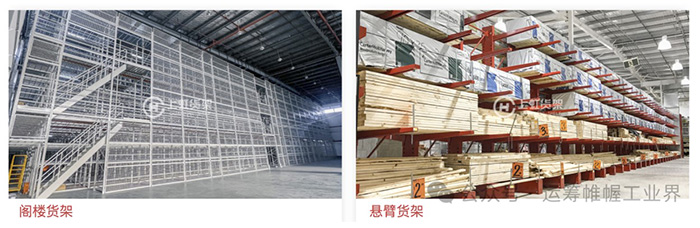
Mezzanine Racking
Mezzanine racking is based on a multi-tier shelving structure, with floors made of wood, patterned steel, or steel plates. It can be flexibly designed as two or more levels, suitable for storing small packaged items such as hardware, electronic equipment, and mechanical parts. Ideal for storing a wide variety of goods in small quantities, it maximizes space utilization. It is particularly suitable for sites with limited space but numerous SKUs, potentially multiplying storage capacity within the same footprint.
Cantilever Racking
Cantilever racking consists of columns fitted with arms, which can be fixed or adjustable. It is suitable for storing long, circular, plate, tubular, or irregularly shaped materials. Arms can be single-sided or double-sided. Cantilever racks offer stable structure, good load-bearing capacity, and efficient space usage.
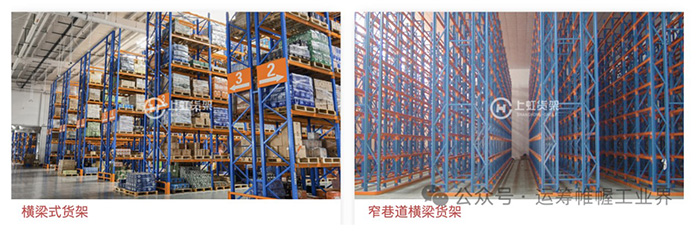
Beam Racking
Beam racking, also known as pallet racking, is commonly used with palletized loads and is one of the most widely applied racking forms across industries. It allows for selective pallet access, enabling any pallet location to be accessed in any order, ensuring first-in, first-out (FIFO) inventory management. There are no strict restrictions on forklift type, and the system is cost-effective. Beam and level adjustments can be made after installation, offering high flexibility.
Narrow Aisle Racking
Narrow aisle racking, or VNA (Very Narrow Aisle) racking, is a specialized storage system derived from beam racking. Its structure is similar but includes ground guide rails. VNA racking uses specialized narrow-aisle forklifts with triple-directional rotating forks to handle pallets in aisles as narrow as 1.7–2 meters. It allows 100% picking accessibility and is an ideal choice for operations requiring FIFO and high storage density.
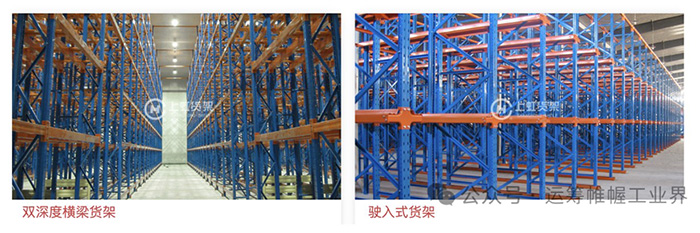
Double Deep Racking
Double deep racking is designed with two pallet positions in depth. Its structure is similar to beam racking, often with upper-level pallet rails for faster forklift access. Compared to standard beam racking, it can increase storage capacity by 75–100%. However, due to the double-depth design, accessing the inner pallet requires moving the outer one first, making it suitable for small-batch, multi-SKU inventory.
Drive-in Racking
Drive-in racking, also known as through racking, connects multiple row frames without beams, using top beams and support arms with pallet rails. Forklifts can drive directly into the racking lanes to store and retrieve goods. Storage follows a last-in, first-out (LIFO) principle, where the inner positions are filled first and outer ones are retrieved first. It is suitable for goods with low variety but high throughput.
Flow (Gravity) Racking
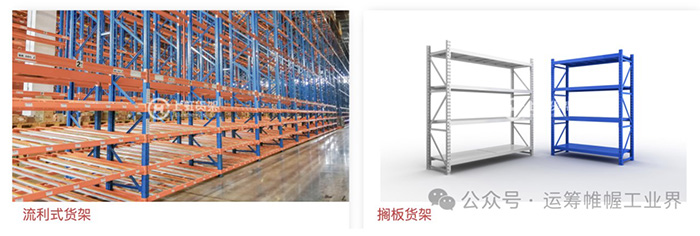
Flow racking, also called sliding racking, stores goods on roller tracks. Loading is done from one side and picking from the other. The rack slopes slightly toward the picking side, allowing goods to move by gravity. This enables FIFO operation and supports one-time replenishment with multiple picks. It is highly efficient and suitable for warehouses with high sorting volumes.
Shelving Racking
Shelving racking is a light to medium-duty storage system with a modular structure, allowing adjustable and flexible shelf levels. Shelves can be made of steel or wood, with a load capacity of 100–700 kg per level. It is suitable for small and medium-sized warehouses storing a variety of goods in small quantities with high access frequency.